













 New
New




No-KYC vs KYC Platforms: What Users Gain and What They Risk
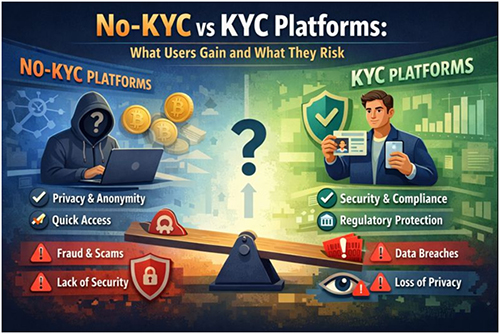 Every platform choice involves trade-offs. Privacy versus protection. Speed versus support. Control versus convenience.
The KYC versus No-KYC debate isn't about finding a winner. It's about understanding what you're actually trading when you choose one model over the other.
KYC platforms build trust through identification. They collect documents, verify identities, and create account records tied to real-world individuals. The platform knows who you are - and that knowledge enables services like account recovery, fraud protection, and regulatory compliance.
No-KYC platforms build trust differently. They rely on cryptographic verification, wallet-based access, and on-chain transparency. The platform doesn't need to know who you are - it only needs to verify that the wallet connecting controls the funds involved.
Neither approach is objectively superior. Each serves different priorities.
Traditional verified platforms offer tangible benefits that users often take for granted:
Account Recovery Forgot your password? Lost access to your email? KYC platforms can verify your identity through alternative means and restore access. Your relationship with the platform survives your own mistakes.
Dispute Resolution When transactions go wrong, verified platforms have escalation paths. Support teams can investigate, reverse unauthorized actions, and mediate disputes. Someone is accountable.
Regulatory Protection Licensed platforms operate under legal frameworks. Users have recourse through financial regulators if platforms misbehave. There are rules, and someone enforces them.
Institutional Trust Banks, insurers, and traditional financial services integrate with KYC platforms. Your verified account connects to the broader financial system.
Those benefits come with real trade-offs:
Data Exposure Every document you upload exists somewhere you don't control. Platforms get breached. Databases get leaked. Your passport scan from 2019 might surface in ways you never anticipated.
Friction and Delays Verification takes time. Hours at best, days at worst. Urgent needs wait for approval queues.
Platform Dependency Your access depends on the platform's continued operation and goodwill. Accounts get frozen. Platforms change terms. Services shut down.
Permanent Records Identity verification creates lasting documentation of your platform usage. That history exists whether you want it to or not.
Privacy-first platforms offer a different value proposition:
Immediate Access Connect a wallet, start using the platform. No forms, no uploads, no waiting. Access happens in seconds.
Data Minimization The platform collects only what's necessary for function - typically just your wallet address. No passport scans sitting on servers you've never seen.
Self-Custody Control Your assets remain in your wallet until you actively engage. You're not depositing funds into someone else's system and hoping they handle them properly.
Pseudonymous Activity Transactions link to wallet addresses, not legal identities. Activity is transparent on-chain, but not automatically tied to your real-world name.
Dubai's position as a leading global fintech hub means residents encounter both models regularly - and increasingly understand the distinctions between them.
Privacy comes with its own price:
No Account Recovery Lose your wallet keys, lose everything. No support agent can help. No identity verification can restore access. Self-custody means self-responsibility.
Limited Support Problems get solved through documentation and community forums, not dedicated customer service. Complex issues may have no resolution path.
Reduced Legal Recourse Platforms operating outside traditional licensing frameworks offer fewer guarantees. If something goes wrong, you may have nowhere to escalate.
Learning Curve Wallet management, key security, transaction verification - these skills aren't optional. Users who don't understand the technology are users at risk.
|
Factor |
KYC Platforms |
No-KYC Platforms |
|
Onboarding speed |
Hours to days |
Seconds to minutes |
|
Data collected |
Extensive (ID, address, selfie) |
Minimal (wallet address) |
|
Account recovery |
Available |
Not available |
|
Customer support |
Traditional channels |
Limited or community-based |
|
Privacy level |
Low |
High |
|
Regulatory oversight |
Yes |
Variable |
|
User responsibility |
Shared with platform |
Entirely personal |
|
Breach exposure risk |
Higher (more data stored) |
Lower (less data exists) |
KYC platforms work best for users who:
No-KYC platforms work best for users who:
Within blockchain-based entertainment, this distinction becomes particularly visible. Some platforms require full identity verification before any activity. Others operate as a crypto casino no kyc environment - wallet connection only, no documents, immediate access.
Users choosing the latter aren't avoiding accountability. On-chain activity is fully transparent and auditable. They're choosing a different accountability model - one based on cryptographic proof rather than identity documentation.
The World Economic Forum's research on self-sovereign identity explores how these models might eventually converge - giving users control over their credentials while still enabling verification when genuinely necessary.
The decision isn't ideological. It's practical.
Ask yourself:
Honest answers point toward the right model. Users who need support structures shouldn't choose platforms without them. Users who prioritize privacy shouldn't surrender it unnecessarily.
KYC platforms trade privacy for protection. No-KYC platforms trade protection for privacy.
Both are legitimate choices. Both involve real costs. The mistake isn't choosing one or the other - it's choosing without understanding what you're actually giving up.
Users who match their platform choice to their actual needs and capabilities make better decisions than users chasing ideological purity in either direction.
The best choice is the informed one.
|
|
|
|
|
Join The Blue Whale AI Academy at thebluewhale.ai
WhatsApp: +971 50 6449103 | Email: info@cyber-gear.com