












 New
New




Peptides For Recovery & Injury Rehabilitation: The Science Behind BPC-157 And TB-500 Research
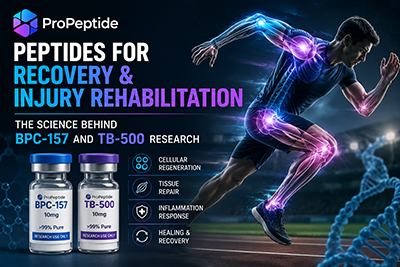
Recovery and rehabilitation research continues to be a major focus within sports science, regenerative biology, and cellular research. Scientists are constantly searching for a better understanding of how tissues respond to stress, injury, and repair processes. As peptide science advances, several compounds have gained significant attention due to their potential involvement in biological pathways related to tissue maintenance and recovery.
Among the most widely discussed research peptides are BPC-157 and TB-500. These compounds have become subjects of growing interest among researchers investigating soft tissue biology, cellular communication, and regenerative mechanisms. Although ongoing studies continue to evaluate their biological properties, both peptides have established a strong presence in the scientific research community.
It is important to note that BPC-157 and TB-500 are research compounds intended exclusively for laboratory and scientific investigation. Current research does not establish them as approved treatments, and studies remain focused on understanding biological mechanisms rather than human therapeutic applications.
Recovery is a complex biological process involving multiple systems within the body. When tissues experience stress or damage, numerous cellular pathways become activated to support repair, adaptation, and maintenance.
Researchers studying recovery-related mechanisms often investigate:
Understanding these processes may help scientists gain valuable insights into how biological systems respond to physical stress and tissue challenges.
Peptides have become particularly valuable in this field because they serve as signaling molecules capable of influencing various cellular functions.
BPC-157 is a synthetic peptide derived from a naturally occurring protein sequence. Over the years, it has attracted considerable scientific interest because of its potential interactions with biological pathways associated with tissue maintenance and repair.
Laboratory studies have explored BPC-157 in research areas involving:
One area that researchers continue to examine is the peptide's relationship with angiogenesis, a process involving the formation of new blood vessels. Because blood supply plays an important role in tissue maintenance, this aspect has become a significant focus of ongoing investigation.
While findings from preclinical research remain promising, additional studies are required to fully understand its biological behavior and potential applications.
TB-500 is a synthetic version of a naturally occurring peptide fragment known as Thymosin Beta-4. Researchers have studied this peptide extensively because of its potential role in cellular migration and tissue remodeling processes.
Current investigations have focused on:
These characteristics have made TB-500 a common topic within sports science and regenerative biology research.
Scientists continue exploring how TB-500 may influence cellular behavior and tissue-related mechanisms under controlled laboratory conditions.
One of the most interesting developments in peptide science is the growing number of studies evaluating BPC-157 and TB-500 within the same research framework.
Researchers are interested in determining whether the two compounds influence complementary biological pathways. While BPC-157 investigations often focus on localized tissue-related mechanisms, TB-500 studies frequently examine broader cellular mobility and tissue remodeling processes.
Because of these differences, many researchers believe that studying both compounds together may provide deeper insights into recovery-related biological systems.
For laboratories exploring this area, resources discussing BPC-157 and TB-500 for recovery research can provide useful information regarding peptide specifications, research considerations, and product documentation.
Sports science researchers have shown increasing interest in peptides because of their potential relevance to biological recovery mechanisms. Understanding how tissues respond to physical stress remains an important objective within athletic performance and rehabilitation studies.
Current research areas include:
Connective tissues play a critical role in movement and structural support. Researchers continue investigating how peptides interact with pathways associated with tendon and ligament biology.
Scientists are also examining how peptides influence cellular environments involved in soft tissue maintenance and repair processes.
Recovery involves multiple biological systems working together. Peptide research helps scientists better understand the signaling pathways involved in these complex interactions.
As peptide research grows, the quality of research materials becomes increasingly important. Reliable scientific investigations require compounds that meet strict standards for purity and consistency.
Researchers often evaluate suppliers based on:
Access to properly tested research compounds helps support accurate and reproducible scientific findings.
The field of peptide science continues to evolve rapidly. Researchers worldwide are exploring new compounds, biological pathways, and potential applications that may contribute to a deeper understanding of recovery-related mechanisms.
Future investigations are expected to focus on:
As scientific knowledge expands, these studies may provide valuable insights into the biological processes that support tissue maintenance and adaptation.
BPC-157 and TB-500 remain among the most widely researched peptides in recovery and rehabilitation science. Their potential involvement in tissue maintenance, cellular communication, and regenerative biology has made them important subjects of ongoing scientific investigation.
Although much remains to be learned, researchers continue exploring how these compounds interact with complex biological systems. Through carefully controlled laboratory studies and high-quality research materials, peptide science continues to advance our understanding of recovery-related biological processes.
Disclaimer: This article is intended for educational and research information purposes only. BPC-157 and TB-500 are research compounds intended exclusively for laboratory use. This content does not constitute medical advice, treatment recommendations, or claims regarding human use.
|
|
|
|
|
 FEATURES & ARTICLESVISIT OTHER EMIRATESInteresting Links ONLY webinars 4.0 Revolution Dubai Humanitarian Dubai Restaurants Guide Corporate Gifts Middle East News PUBLISHING PARTNERS
Join The Blue Whale AI Academy at thebluewhale.ai WhatsApp: +971 50 6449103 | Email: info@cyber-gear.com |