











 New
New




The Digital Interior: How Technology Is Reshaping Design And Renovation In Dubai
As architecture and interior design become increasingly sophisticated, the companies delivering those ideas are undergoing a transformation of their own. From AI-assisted design and digital mood boards to live project reporting, a new generation of design and renovation companies is showing how technology can support more efficient, scalable and sustainable growth.
For decades, the interior design and contracting industry has been built around a familiar combination: creative talent, technical knowledge, skilled trades and strong relationships with clients and suppliers. Those fundamentals remain essential. But the environment surrounding them is changing.
Clients increasingly expect the same transparency, accessibility and speed from a renovation company that they experience in other digitally enabled industries. They want to understand what is happening on site, see how a design is developing, know where their budget stands and receive information without chasing different people through phone calls, emails and messaging groups.
The pressure for change is also coming from within the construction industry itself. McKinsey has found that global construction productivity increased by only around 10% between 2000 and 2022, compared with approximately 50% across the overall economy and 90% in manufacturing during the same period.
For architecture, interior design and contracting companies, that productivity gap presents both a challenge and an opportunity. Increasingly, part of the answer lies in digitalisation—not as a replacement for architects, designers or site teams, but as an infrastructure connecting them.
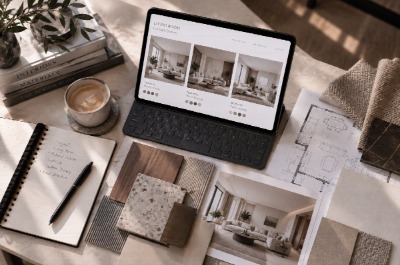
The transformation is particularly visible during the creative stages of interior projects. Digital mood boards make it possible to organise flooring, bespoke joinery, furniture, colours, lighting and material references within a visual environment that can be reviewed and updated collaboratively. Rather than exchanging disconnected images through messaging applications, clients and designers can develop a clearer record of decisions.
For material selection, a product reference and specification alongside an approved image can help carry the client's choice through to pricing and installation. Artificial intelligence is adding another layer. AI can support early-stage visual exploration, rapidly test alternative design directions and help teams communicate concepts before investing time in detailed modelling. During execution, digital tools can also assist with documentation, reporting and information organisation.
This is already moving beyond experimentation. Autodesk's 2025 research found that 39% of leaders across Design and Make industries were using AI to support sustainability, up from 26% just two years earlier. In its construction-specific research, 63% of construction organisations surveyed said they were leveraging AI to become more sustainable.
The important distinction is that these technologies do not eliminate the designer's role. Architecture and interiors depend heavily on judgement: understanding proportion, materiality, context, constructability and human experience.
Instead, AI can shorten the distance between an idea and its visualisation, allowing designers to explore more possibilities while concentrating their expertise on the decisions that matter.
In Autodesk's 2025 State of Design & Make research, 67% of construction leaders agreed that the future growth of their companies would depend on digital tools.
Dubai provides an interesting environment for this approach. The city's market for villa and apartment renovation involves an unusually international client base. Property owners may live in Dubai, elsewhere in the UAE or thousands of kilometres away. Investors renovating apartments for resale may be highly focused on schedule and budget, while homeowners undertaking substantial villa upgrades may want close involvement in design decisions without visiting the site every day.
This environment is also creating opportunities for a new generation of design and contracting businesses that are building technology into their operations from an early stage.
Among them is Infranova Group, one of the young, award-winning, interior design and renovation companies operating in Dubai's property-upgrade market. The company was recently recognised with the “Digital Transformation Award 2026”, reflecting its growing presence in the sector and its approach to combining design, project execution and digitalisation.
InfraNova Group's operating model shows the role technology plays behind the finished interiors. Rather than treating digitalisation primarily as a marketing tool, the company has integrated digital processes across multiple stages of its business, from digital marketing and modern client communication to digital mood boards, AI-supported design workflows, site monitoring and digital project reporting.
For a young company, establishing these systems early can provide an important foundation for sustainable growth. Processes can be standardised before the organisation becomes larger and more complicated, while management gains greater visibility over projects, resources and performance.
It can also support site supervision and quality control. When project information is consistently recorded and measurable, companies have greater opportunities to compare projects, identify recurring problems and continuously improve the way future work is designed and delivered. Across the construction industry, technology providers such as NEXATEK develop custom software to organise project data, automate routine tasks and support reporting.
Luxury in interior design has traditionally been associated with materials, detailing and craftsmanship. Those elements remain fundamental, but the definition of premium service is expanding. For many clients, transparency itself is becoming part of the experience.
Knowing what has been completed, what will happen next, whether the project remains within budget and which decisions require attention can significantly reduce the uncertainty associated with a turnkey renovation.
This is particularly relevant to overseas property owners. A client living in London, Frankfurt or Singapore cannot simply visit a Dubai apartment every afternoon to inspect progress. Even UAE-based clients may have little time to make frequent site visits.
InfraNova Group has been addressing this challenge through a digital project-reporting platform designed to create a clearer connection between construction sites and property owners.
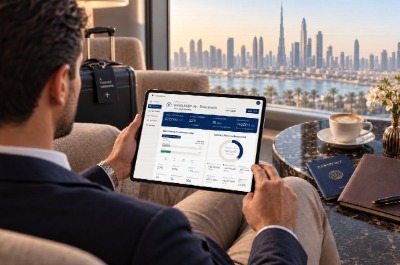
The concept behind InfraNova Group's reporting system is relatively simple: provide clients with a structured digital window into their project. Instead of relying solely on periodic WhatsApp updates, telephone calls or manually prepared reports, project information is organised within a digital environment that clients can review remotely.
The platform addresses several of the questions property owners ask most frequently: What has been completed? How much has been spent? Is the project on schedule? What activities are currently underway? What does the site look like today?
Clients can review financial information, the project timeline, recent site photographs and key updates through one structured reporting process, following progress through to project handover. For overseas owners, the benefit is particularly clear. Physical distance becomes less of an obstacle to understanding the project. For UAE-based clients, meanwhile, the same system reduces dependence on continuous site visits and fragmented updates.
From the contractor's perspective, there is another advantage: reporting becomes part of project delivery rather than an administrative exercise carried out only when a client asks for an update.
It is a relatively simple example of a much broader change taking place within construction: digitalisation moving from the back office to the centre of the client experience.
The next generation of successful interior companies may therefore be defined by more than their portfolios. Design capability, craftsmanship and construction knowledge will remain the foundation of the profession. But the businesses surrounding those skills are likely to become increasingly data-driven, connected and transparent.
For architects, designers and contractors, digitalisation therefore represents more than a technology trend. Properly implemented, it can provide the structure for a business that is more measurable, transparent and capable of growing without sacrificing control.
InfraNova Group's management sees technology in precisely this supporting role.
“Our focus has been to continuously improve our quality through the application of different digital tools and platforms—from monitoring and measurement to design, execution and reporting,” says the CEO of InfraNova Group. “For us, digitalisation is not about replacing the human side of design or construction. It is about giving our team better information, improving the way we work and ultimately giving our clients a better and more transparent experience.”
That philosophy may prove increasingly relevant across the architecture and interiors sector.
The future of interior design will still be shaped by creativity, materials and craftsmanship. But the companies capable of delivering those ideas efficiently may increasingly be the ones that understand something else as well: a beautifully designed project deserves an equally well-designed process.
|
|
|
|
|
 FEATURES & ARTICLESVISIT OTHER EMIRATESInteresting Links ONLY webinars 4.0 Revolution Dubai Humanitarian Dubai Restaurants Guide Corporate Gifts Middle East News PUBLISHING PARTNERS
Join The Blue Whale AI Academy at thebluewhale.ai WhatsApp: +971 50 6449103 | Email: info@cyber-gear.com |